Thursday, May 19, 2011

Brain Reactions VS Feelings

Being Rational VS What You're Actually Feeling
My lab partner, Samyu, and I created, conducted , and wrote about our experiment together - to view hers click here
When you feel an emotion, does your heart follow the pattern of that emotion, or is that just your mind rationalizing(thinking about what it was taught/is supposed to make of certain situations) and saying what it is supposed to feel? You see a random picture and your heart jumps or twinges or maybe does not even react at all. Whichever the case, your heart’s reaction is the true emotion you are feeling, because of the long-trained “fight or flight” thought process in the brain. If your heart rate increases or decreases matching the emotion stated for that certain picture, then the person stated what he or she actually felt. If not, he or she rationalized with themself and told you, the scientist, what he or she was supposed to have felt. Remember this is about how much the test-subject is true to his or her own feelings; it is not to measure the person’s personality. Our hypothesis was that there would only be a few big changes (ex: leap for fear and excitement, and, after research, drops for sadness) in the heart rate compared to the emotion that was supposedly being shown. Remember this is about how much the test-subject is true to his or her own feelings; it is not to measure the person’s personality.


Keep in mind that these are pictures, the test subject’s reaction are not entirely to the actual circumstance of the picture, instead they are to the picture (ex: seeing a real-life tarantula VS just looking at a picture of one). Choose the ten pictures to try and encourage certain emotions. Afterward, show the subject the pictures again, this time asking them to write down what emotion they felt for each picture. Then, study the graphs in relation to which picture the subject was seeing at that point in time, what emotion they felt, and try to make connections. Collect the data and average the results to make two graphs, one for the “average change” in heart rate for males, and the other for females, along with pie charts of whose heart rate actually correlated to his or her "said" emotion.
Overall, the males as a group had a much larger variance in heart rate, which was mirrored, for the most part, by the females but with less change. Everyone had a significant leap in heart rate at the first picture. The largest drop was between 40 and 45 seconds, while the time period with least variation in heart rate was 50 to 55 seconds, during which a peaceful picture was shown. From 55 to 65 seconds there were two approximately equal increases in heart rate for “surreal” and “excitement” pictures. Overall, the males as a group had a much larger variance in heart rate, which was mirrored, for the most part, by the females but with less change. Everyone had a significant leap in heart rate at the first picture. The largest drop was between 40 and 45 seconds, while the time period with least variation in heart rate was 50 to 55 seconds, during which a peaceful picture was shown. From 55 to 65 seconds there were two approximately equal increases in heart rate for “surreal” and “excitement” pictures.

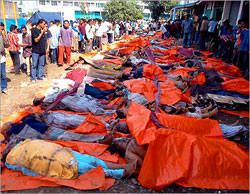
The first leap was probably from the excitement of the experiment beginning. Then, the largest drop in the males’ heart rate, and a significant drop in the females, occurred when the picture of the dead bodies after a tsunami  was shown. This drop is characteristic of sadness, which correlates with their said emotion for the picture. However, for the spider picture, the subjects all said that they felt fear. This was not evident in the heart rate at all. During the time we showed the spider (35-40 seconds), there was actually a drop in heart rate, so nobody felt actual fear. When analyzing the photograph, their logical mind may have told them that fear should be associated with the image, and so they wrote it. The other one for which we were expecting a change was excitement. Males experienced a sharp rise in heart rate, while females had a less pronounced increase. Below are some graphs displaying correlation between what the subject’s analytical mind said and what their first reaction, and heart rate, showed. Lastly, we were not expecting anything particular to happen for “peacefulness,” but the heart rate showed little change, which confirms that the subjects probably were feeling peaceful. Even though most of the subjects did not in fact have a heart rate matching his or her "said" emotion, in reality, for example if one is scared he or she will have a fast heart rate. So these test subjects, since instead of the actual situation, were shown pictures, their hearts did not match the emotions which they said they were feeling, though some people
"In the graphs of averaged heart rate, more girls correlated with fear, while more boys correlated with  excitement. Oddly enough, even though most individuals did not correlate for sadness, the averages most certainly did. However, the experiment overall did prove our hypothesis (there were significant jumps for the pictures we specified) and showed something we never expected: people often deceive themselves into thinking that they felt a certain emotion when they actually might have felt something different or even nothing at all. Does a picture of a spider scare you? Or does your brain remember the creepy spider you found on your ceiling and trick you into "feeling" scared? "(-Lab Partner-).


Picture Urls:
            
    8) http://jasonschaeffer.files.wordpress.com/2008/05/polar-bear-on-a-peak-of-an-iceburg.gif
            10) Users/15hannahb/Desktop/crying-tears-of-joy-208913.jpg

Sunday, May 8, 2011

We're smart, Aren't we?

"Pop quiz: What is 357 times 289? No pencils allowed. No calculators. Just use your brain.
Got an answer yet? Got it now? How about now? Chances are you still don’t. As you solved the problem one step at a time, you lost track of the numbers. Maybe you tried to start over, lost track again, and eventually gave up in frustration before you could discover that the answer was 103,173."

Now, why in the world was it practically impossible for us, the humans with brains that can process complex information, such as scanning a crowd and picking out people you knew and memorizing the new faces in a matter of seconds, something that is even difficult for computers nowadays, to solve a simple math problem such as 357 times 289?
Called a "Crack in the Wall," this absurd difficulty in our thought processing has left many psychologists puzzled. This struggle with some simple tasks help the scientists try to piece together how our brains are wired, and in this instance, because of the complexity of our brains and the speed at which they can function, "a bottleneck of processing" occurs when the information gets stuck in a traffic jam.
The discoverer of these strange happenings was in 1931 by a psychologist named Charles Witt Telford. He conducted an experiment with 29 graduate students at the University of North Dakota, and had them all press a button once they heard a sound. What he found out was that depending on the distance of time between the sound, the speed at which the button was pressed varied.

"If the interval was one or two seconds, it took the students about a quarter of a second to react. But if Telford reduced the interval to half a second, the students consistently slowed down on their response to sound number two. It took them an extra tenth of a second to press the key."

From this information, Telford was reminded of a muscle jerk reaction in response to electric shocks. Muscles need time to recover from these electric shocks before they can respond to the next one. If the time for relaxation is not given to the muscles, and a shock is given too soon, the muscles will not respond. He speculated that "the brain needs time to reset itself after a pulse of thought before it can carry out another one."
After 80 years of other scientists going through the same experiment and receiving the same results, this "period of relation" began to be called the "psychological refractory period," and it began to be defined as what happens "if we don’t have enough time between two tasks, [so] we slow down on the second one." Though this lag can seem insignificant at first, in reality it can mean the difference between life and death.

An example this is, say you are in a car with your friends and the light turns green, so the driver moves its foot to the gas pedal and begins to press. A car runs the red light and heads straight for your vehicle. The driver must now respond to this new information in a split second to save your life. What if it can't?
Harold Pashler ran an experiment almost exactly like the example above. He would instruct the subject to sit in a car simulator "complete with gas and brake pedals. As they drove along a virtual road behind another car, the volunteers would hear tones from time to time. They had to call out 'one' or 'two' depending on the number of tones they heard. Occasionally, the car in front would put on its brakes, and the subjects had to brake as well. Pashler and his colleagues found that it typically took just under a second for people to respond to the brake lights on the car ahead. But it took longer for them to react if they had responded to a tone within one-third of a second before the lights went on. Pashler found that, on average, the test subjects’ reaction time increased by 0.174 second. That may not seem like a big difference, but if you are driving 65 miles an hour, it translates into an extra 16 feet. That distance can mean the difference between a close call and a high-speed rear-end collision," and life and death.

So, what if this happened to you in real life? What if your brain had a traffic jam, when you needed it most? What if this was the difference between life and death? What would happen?

Though the research above shows are brain has difficulty multitasking, is this actually true? We can pat our heads and rub our tummies. We can do complex math such as calculus, understand the greatness of the universe, the minimality of an atom, plus "as you read this column, your brain can also manage your heartbeat, perceive the melody of a song playing on your iPod, and send out complicated instructions to drink a soda," yet I'll ask again, why can we not solve a simple math problem?

This is because all the separate tasks are separated into hundreds of relatively self-contained regions. "These regions can work on different tasks at the same time. Yet there are simple jobs—like math problems—that our brains can handle only one at a time. It is as if signals were flying down a 20-lane superhighway, and then the road narrowed to a single lane," leading to a traffic-jam.

Bibliography:

Zimmer, Carl. "The Brain: The 'Router' in Your Head—a Bottleneck of Processing."
     Discover: Mind/Brain. Kalmbach Publishing Co., n.d. Web. 8 May 2011.
     <http://discovermagazine.com/2010/nov/
     15-the-brain-router-in-our-heads-processing-bottleneck/
     article_view?b_start:int=1&-C=>.

smart brain. N.p., n.d. Web. 8 May 2011. <http://www.google.com/
     imgres?imgurl=http://ambassador.rit.edu/blog/jeff/files/2006/02/
     smart_computer.jpg>.

car crash. N.p., n.d. Web. 8 May 2011. <http://www.google.com/
     imgres?imgurl=http://s3.amazonaws.com/answer-board-image/
     2008112322441633630746813580000925.jpg>.

electric shock. N.p., n.d. Web. 8 May 2011. <http://www.google.com/
     imgres?imgurl=http://4.bp.blogspot.com/_fIRbT5WQY6c/TB-faTHh8uI/AAAAAAAAAHk/
     VtN1sYOhM7E/s400/electric%2Bshock2.jpg>.

multi-tasking. N.p., n.d. Web. 8 May 2011. <http://www.google.com/
     imgres?imgurl=http://1.bp.blogspot.com/_Bo2OkHBt4Ng/SY2GF7gu2WI/AAAAAAAACd4/
     0toGWWgvOZw/s320/multitasking.jpg>.

Thursday, April 7, 2011

A Foresty Future?

Shrinking Tundra, Advancing Rainforests: The Arctic by 2099 

A South Korean and US science research team believe that by the end of the 21st century, the tundras, areas of dry cold hard land, will turn into areas of vast vegetation (by needle-leaf and broad-leaf forests) in areas like Alaska, Canada, Eastern Europe, Northern Asia, and Scandanavia. This team put together the results of "16 global climate models from 1950 to 2099" with more than 100 years of observational data to try and figure out what this change in climate might do to the way of life in the Arctic by the 22nd century. Results from the analyzation show that by the end of this century the average Arctic surface temperature will increase by 3-5 degrees Celsius depending on the case. One reason this will most likely occur is because as one of the scientists, Feng, states "The expansion of forest may amplify global warming because the newly forested areas can reduce the surface reflectivity, thereby furthur warming the Arctic" and areas like it. Though this will be occuring everywhere, it will be occuring at different speeds. Through their studies,the researchers found that depending on the region, the temperature might rise at a more rapid pace because of certain vegetation growing there, such as in norther Europe and Alaska. Scientist Feng notes that this is because, "The plants don't have legs, so it takes time for plant seed dispersal, germination, and establishment of seedlings," explaining why over time the amount of shrub density has been rapidly increasing on a shorter timescale compared to the expansion of forests in the north.

This made me realize that at the rate things are warming up, the Earth could be soon covered just as it had been before, entirely in ocean. What would we do then? Probably with the technology nowadays, we could figure out how to directly turn water into air and create an Atlantis, and underwater mythical nation, until we can resurface again. Another option would be to move to the moon and begin civilization there, waiting for the Earth to cool down again, but this won't help anything. The real problem is that with the rapid increase in temperature, the polar ice caps are melting, which is increasing the heating rate even more. How can we fix this? by installing heat controlling machines into the water? At this point in life, scientists are still trying to find a clue. So for now, be-aware of the future snow people, life's going to get a whole lot warmer.

Citations:
ForestWalkway. N.p., n.d. Web. 8 Apr. 2011. <http://www.google.com/
     imgres?imgurl=http://www.uwsp.edu/geo/faculty/ritter/images/biosphere/vegetation/
     broadleaf_deciduous_FAO.jpg>.

Geographical Pattern of Surface Warming. N.p., n.d. Web. 8 Apr. 2011.
     <http://www.google.com/imgres?imgurl=http://web.mit.edu/12.000/www/m2011/
     finalwebsite/graphics/climate/tempmap1.png>.

Environmentalresearchweb. N.p., n.d. Web. 8 Apr. 2011.
     <http://environmentalresearchweb.org/cws/article/news/45607>.


Sunday, January 30, 2011

Your Experiences are who you are

The Switches that can turn mental illness on and off


Imagine, instead of the nice sheltered, educated life you have today was instead a life in Africa starving, or during the bubonic plague, or as an orphan. All these things can change who you are today. The DNA of a person contains an epigenetic code, which is methyl groups and coiling proteins that make an organism what it is, along with silent and awake genes, which can be changed by certain experiences in one's life. Neurologists tested this on two rats of the same litter; one with the mother's care and one without. Results of the two's behavioral instincts were different. The one who received all the attention(we'll call him Mr. Attention or Rat-A for short) was very curious, loved to explore and was not easily startled, contrasting to the one who was neglected(we'll call him Mr. Neglect or Rat-N for short) and ended up being easily startled, had a tendency to suffer a surge of stress hormones, and had a reluctance to explore new places. The beginning of the two rats altered the epigenetic marks on the DNA, which changed whether certain behaviors were turned on or off. Since the epigenetic marks can be changed from one generation to the next through childhood experiences, doesn't that mean that behavioral traits are technically passed from one generation to the next through actions of the parental generation? if not, why?

Like an abused child, a neglected rat shows signs of nervousness, being uncertain about one's surroundings, etc. The behaviors of the future generation will also carry this nervousness, but their upbringing can change the epigenetic marks on their DNA as well. Recently, there have been some studies of over-studious students, who go through their math homework five times, have extra tutors on the side to help them, and whose parents make them cram all the information in, all this plus the extra curricular activities that will look good on a college transcript such as being able to play the chello, a sport, etc.


This second generation of children might look back and think that they do not want their children to have a life like that so then the next generation of parents do not cram their children with tons of activities, do not force them to do their homework a million times, but still want them to do well in school. The third generation of children, sometimes not always, believing that they did not get the best most studious beginning, wanting the best for their child, will try and create a better upbringing than the one they had, by doing the same thing as the first generation of parents. Each generation of children is reacting to their childhood(and epigenetic changes from on to off, or off to on) by changing the way the next generations childhood (and behaviors for the future) will change through a difference in the next generations childhood(and epigenetic marks). If a person's behavior can be different with a different childhood experience, then isn't it impossible for one generation of alcoholics to pass the genes on to the next generation, when the next generation is orphaned? Even though that still confuses many people today, are behaviors passed on through genes or actions, the evidence shown here will help you make your decision.


Resources
Zimmer, Carl. "The Switches That Can Turn Mental Illness On and Off."
     Discoer: science, technology, and the future. Kalmback. Publishing Co.,
     n.d. Web. 30 Jan. 2011. <http://discovermagazine.com/2010/jun/
     15-brain-switches-that-can-turn-mental-illness-on-off>.
2ratspicture. N.p., n.d. Web. 30 Jan. 2011. <http://www.google.com/
     imgres?imgurl=http://www.pinnaclenews.com/content/img/f209147/
     RATS2_ds031607.jpg.>
overstudiousstudent. N.p., n.d. Web. 30 Jan. 2011. <http://www.google.com/
     imgres?imgurl=http://www.usafa.edu/df/dfb/courses/
     GraduateSchool.jpg>.

Saturday, January 8, 2011

A Life of Lives

On the book My Name is Memory
Book by : Ann Brashares
Article by: Hannah B

Labels + Definitions

Memory - a form of remembrance, where a part of the body is used as tool or slate to put things down.   Like a video that you save that can be watched over and over and over again.
Life - the feeling of movement and action; having a body that allows you to breath and understand         concepts

Summary 

Written by Ann Brashares, the book, My Name is Memory, is about a man/boy(has about six different ages in story) named Daniel, who has the genetic ability to remember his past lives. Often, this man was able to run into a few other people with this ability, but then the other few lost it when they grew older. The only person introduced that could actually consistently remember past lives other than Daniel was first introduced as a boy named Ben. Ben has been around since as far as the book says, forever. Daniel explains at one point that "Some live only once. Some a very few times. And some just go on and on and on"(147).

Along with this ability is a part where souls and lives are connected to one another. Usually one's mother in one life may become one's sister in the next. Plus these people carry the same attributes from one life to the next, "Those memories are in there somewhere. You act on them in ways you don't realize. They determine how you respond to people, the things you love and the things you fear. A lot of our irrational behavior would look more rational if you could see it in the context of your whole long life"(148). An example of this in the story is of a man, who demands to have his healthy right leg cut off, which confuses all the doctors of that time. Daniel at the age of seven goes up to this man and explains the rationality of it; in the man's past life he had been a soldier at war. His right leg had been shot and amputated from the hip down. Another example of this in the story is an asylum. It is explained to be "the densest concentration of people with partial memories you will ever find. They get flashes and visions but usually not in the right order"(149).


Discussion 

Though this book was written as fictional, it can be proven factual.

When someone dies his or her brain molecule diffuse from the body and mix into the air soon after death. Once someone's body become's cold, his or her soul is gone and floating around for a new body. The time between the different lives is a consistent amount for each individual. Every person is born again with his or her old memories. At this point, differences begin to occur.

Some (very few) humans have the ability to hold the old along with the new, but most do not have the brain space to do this, and begin to forget the memories from the past life. this occurs around the infant stage. The few like the main character have enough space in their brain to contain all of this information. Like a black hole,  Daniel's brain is able to hold all the information in such a condensed space.

Another difference is  the amount of lives a person has. As written earlier, some live once, a couple times, and others forever. An example from the book is Hamilton being a brand new soul, while Jefferson was a couple lives old.

Through life unexpected things happen that create scars and behaviors, which promote new actions. This occurs because people have an innate feeling from the brain particles from their other lives to do this. An example of this is the man who feels he must have a completely healthy limb cut off. This is a genetic disorder called Body Dysmorphic Disorder (BDD), where people feel that things which are part or of their body should not be there.

I choose this book, because it reminded me of how life's too short. But if you think about it, Life's not that short after-all with the many different generations and experiences that a person can have. Have you ever had the feeling of déjà vu? or i think i've seen that person before but i just can't place him/her. That's where your old memories kick in and your mind is mixing the past with the future. Maybe you have seen him or her, or a version of that person in your past life.

Questions
  1. Is there a way to test this in a scientific experiment?
  2. If memories are placed on brain molecules/cells, what part of a cell's nucleus would they be in? do cell have their own memories?
  3. If this is true, would there be a way to extract someone's memories of a Alzheimer person's life and give them back their memories?
  4. Is it possible that the author Ann Brashares has the ability, and is using the character Daniel as a cover up?
Resources - 3
  • Brashares, Ann. My Name is Memory. New York, New York: Penguin Group, 2010. Print. 
  • life. N.d. Jpg file. http://www.google.com/imgres?imgurl=http://castorel.files.wordpress.com/2008/11/life.jpg&imgrefurl=http://castorel.wordpress.com/&usg=__VSfhJj5uHMoOVxSEB6Thvj8Dn8I=&h=500&w=900&sz=54&hl=en&start=0&sig2=4Bdt-3mDu7kCjn9H32Jaxg&zoom=1&tbnid=tfDNIQCBBQ98XM:&tbnh=88&tbnw=159&ei=8iQpTdH2J4XEsAPI082CBw&prev=/images%3Fq%3Dlife%26um%3D1%26hl%3Den%26client%3Dfirefox-a%26sa%3DN%26rls%3Dorg.mozilla:en-US:official%26biw%3D1152%26bih%3D535%26tbs%3Disch:10%2C112&um=1&itbs=1&iact=hc&vpx=426&vpy=260&dur=1714&hovh=167&hovw=301&tx=145&ty=91&oei=8iQpTdH2J4XEsAPI082CBw&esq=1&page=1&ndsp=18&ved=1t:429,r:14,s:0&biw=1152&bih=535
  • origin. N.d. Gif file. http://www.google.com/imgres?imgurl=http://www.chemistry.ucsc.edu/~deamer/origin2.GIF&imgrefurl=http://www.chemistry.ucsc.edu/~deamer/&usg=__ey0gktAEqj4otssp0AtGWOeBoGQ=&h=502&w=463&sz=63&hl=en&start=39&sig2=R4gUP34DCyhxPfbw0k_nLg&zoom=1&tbnid=_p0mrraoQ9MsSM:&tbnh=120&tbnw=112&ei=-SYpTYeJDYLGsAOx9ZjOBw&prev=/images%3Fq%3Dlife%26um%3D1%26hl%3Den%26client%3Dfirefox-a%26sa%3DN%26rls%3Dorg.mozilla:en-US:official%26biw%3D1152%26bih%3D535%26tbs%3Disch:10%2C925&um=1&itbs=1&iact=hc&vpx=899&vpy=194&dur=227&hovh=234&hovw=216&tx=142&ty=157&oei=8iQpTdH2J4XEsAPI082CBw&esq=10&page=3&ndsp=21&ved=1t:429,r:20,s:39&biw=1152&bih=535